Queue Management System in Saudi Arabia: 2026 Buyer’s Guide
A modern queue management system in saudi arabia has quietly become one of the highest-return technology upgrades a customer-facing organisation can make in 2026. From Riyadh bank branches to Jeddah government service centres, the goal is the same: cut waiting time, remove crowding, and turn a frustrating line into a measured, data-rich journey. This guide explains how these systems work, what to look for, and how to match the right solution to your branch footprint.
Queuing is no longer about a paper ticket and a beeping counter. Today’s platforms blend digital ticketing, mobile check-in, real-time dashboards, and biometric identity so that every visitor is served fairly and every manager can see exactly where bottlenecks form. The result is shorter lines, calmer staff, and happier customers.
Why a Queue Management System Matters for Saudi Businesses
Saudi Arabia’s Vision 2030 programme places customer experience and digital government at the centre of national reform. Service centres are measured on speed, transparency, and satisfaction, and long physical lines work against every one of those targets.
Research consistently shows that perceived waiting time, not just actual waiting time, drives dissatisfaction. According to the Harvard Business Review, customers judge service quality heavily on how an organisation manages the moments before service even begins. A structured queue turns dead waiting into a predictable, visible process.
The business case in numbers
- Lower walkaways: clear wait estimates reduce customers who leave before being served.
- Higher throughput: smart routing sends each visitor to the right counter the first time.
- Staff efficiency: live dashboards let supervisors open counters before a line forms.
- Compliance and fairness: first-in, first-out logic removes disputes over who was next.
How Does a Queue Management System Actually Work?
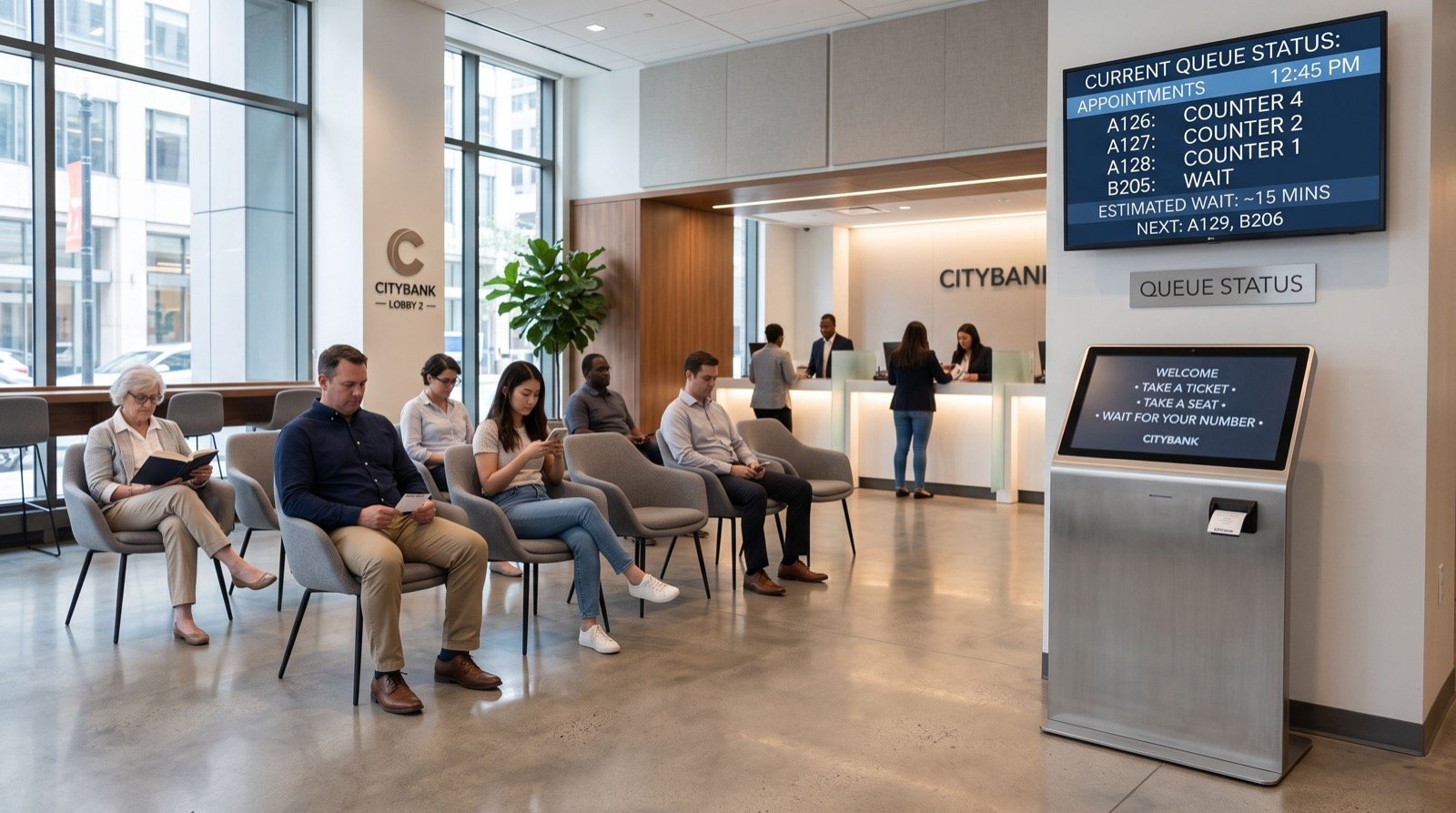
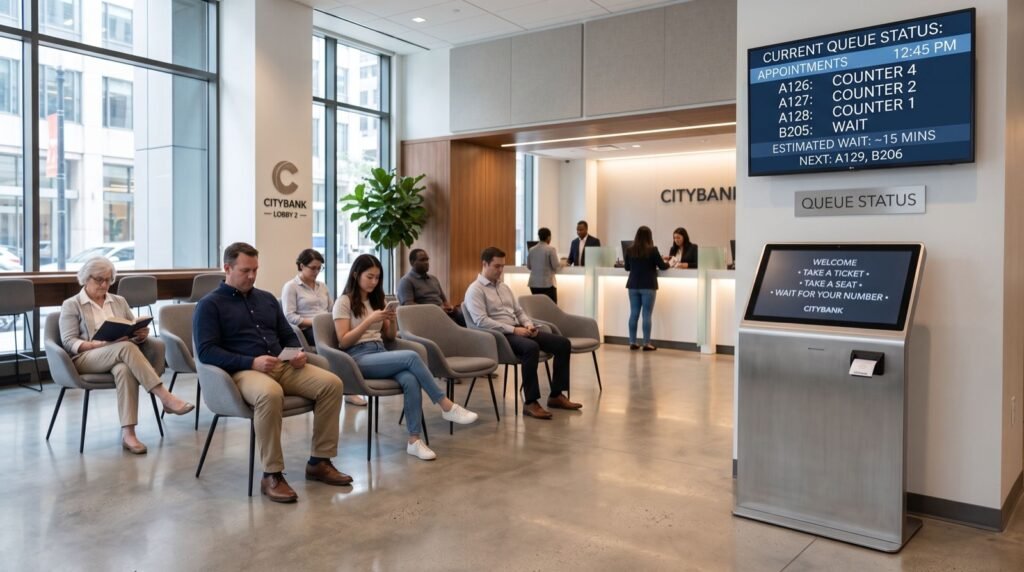
At its core, a queue platform captures a visitor at arrival, places them in the correct virtual line, and calls them to a service point when their turn arrives. Everything in between is automation and data.
The typical visitor journey
- Check-in: the visitor taps a kiosk, scans a QR code, or books a slot from a mobile app.
- Segmentation: the system sorts them by service type, language, or priority (VIP, elderly, appointment).
- Waiting: digital signage and SMS updates keep them informed, so they can sit or step away.
- Calling: an agent calls the next ticket; the number flashes on a display and announces audibly.
- Analytics: every step is timestamped, feeding reports on wait time, service time, and peak hours.
Many Saudi deployments now pair this flow with identity verification. Adding a Biometric Device at check-in lets banks, clinics, and government offices confirm who a visitor is before service begins, reducing fraud and speeding up repeat visits where records already exist.
Core Features to Compare in 2026
Not every queue system suits every environment. A high-traffic telecom store has different needs from a specialist medical clinic. Use the table below as a shortlist when you evaluate vendors.
| Feature | What it does | Best for |
|---|---|---|
| Virtual / mobile queuing | Lets visitors join from a phone before arriving | Retail, telecom, busy walk-in branches |
| Appointment booking | Pre-books time slots to flatten peak demand | Clinics, government, consular services |
| Biometric check-in | Verifies identity via fingerprint or face | Banks, visa centres, high-security sites |
| Digital signage | Displays ticket numbers and media on screens | Any multi-counter branch |
| Analytics dashboard | Reports wait time, SLA breaches, staff load | Multi-branch operators and head office |
Arabic-first and bilingual support
For deployments across the Kingdom, full right-to-left Arabic signage, tickets, and SMS alongside English is essential. Tickets and voice announcements should switch language based on the customer’s own selection at the kiosk.
Integration with existing systems
Your queue platform should talk to your CRM, core banking, or hospital information system through APIs. That way a called ticket can instantly pull up the customer’s profile, and service times feed back into your central reporting.
Choosing the Right Deployment Partner
Hardware is only half the story. Installation, Arabic localisation, staff training, and ongoing support decide whether the system actually lowers wait times. Working with experienced, dependable specialists who understand local service standards keeps the rollout on schedule and the solution supported long after go-live.
Questions to ask any vendor
- Do you provide on-site installation and Arabic staff training across the Kingdom?
- Is the analytics dashboard cloud-based with role-based access for head office?
- How does the system scale from one branch to fifty without re-architecting?
- What is your average response time for hardware support and spare parts?
Implementation Best Practices
The smoothest rollouts share a few habits. Start with a single pilot branch, measure the baseline wait time for two weeks, then compare after go-live. Train floor staff to actively guide early visitors to kiosks, because adoption drives the data quality that makes everything else work.
Review your analytics monthly. If one service type consistently breaches its target, add a dedicated counter or shift staffing to match the real demand curve rather than a guessed schedule.
Trends Shaping Queue Management in 2026
The technology is moving quickly, and the branches that plan for these shifts now will not need to re-invest in two years. Three trends stand out across the Kingdom this year.
AI-assisted forecasting
Predictive models now study historical footfall to forecast tomorrow’s demand curve, letting managers roster staff before a line forms rather than after. This turns the dashboard from a rear-view mirror into a planning tool.
Appointment-first service
More government and healthcare centres are nudging visitors to pre-book, blending appointments with walk-ins so the waiting room never overflows. A good system balances both streams automatically.
Unified omnichannel queuing
Customers increasingly start online and finish in branch. Linking the mobile app, website, and in-branch kiosk into one queue gives a seamless journey and a single source of truth for reporting.
Together these trends point the same way: toward calmer, data-led branches where waiting is predictable and staff are deployed against real demand rather than guesswork.
Frequently Asked Questions
How much does a queue management system in Saudi Arabia cost?
Pricing depends on the number of counters, kiosks, and screens, and whether you choose cloud or on-premise software. Most single-branch setups are a modest fixed cost plus an annual software and support fee, while multi-branch estates are quoted per site with volume discounts.
Can it integrate with biometric identity verification?
Yes. Modern platforms support fingerprint and facial recognition at check-in, which is increasingly common in banking and government service centres for faster, more secure visitor handling.
Does it support Arabic and English?
Reputable systems are fully bilingual, with right-to-left Arabic on tickets, signage, voice calls, and SMS, letting each visitor pick their preferred language at the kiosk.
How quickly can we see results?
Most organisations measure a noticeable drop in perceived wait time and walkaways within the first month, once staff and visitors adopt the digital check-in flow and managers act on the dashboard data.
Conclusion
A well-chosen queue management system in Saudi Arabia pays for itself through shorter lines, better staff utilisation, and measurable customer satisfaction gains that align directly with Vision 2030 service goals. Pair the right software with biometric check-in and a dependable implementation partner, and you turn an everyday pain point into a competitive advantage. Review your busiest branch today, set a baseline, and start your pilot before the next peak season arrives.